Insights
A paradigm shift in member relationship with Conversational AI
Mike Hogan
CTO & Co-founder

Key takeaways
Member data sits as facts in the CRM, not an active relationship.
Conversational AI runs a real two-way conversation with every member.
It sits around existing systems, doesn't replace the CRM or booking.
The relationship runs continuously: before joining, onboarding, membership, problems, cancellation.
For 30 years, we have managed member relationships as nouns: profiles, records, segments, leads and membership statuses.
Conversational AI makes the relationship a verb. For the first time, a health and fitness club can maintain an individual, two-way relationship with thousands of members continuously, at close to zero marginal labour cost. This is especially powerful in fitness because the product itself is longitudinal. The club isn't selling you a toaster. It is trying to help members establish and maintain a behaviour for months or years. Yet the relationship between club and member is strangely intermittent.
The CRM/MMS might know:
Tom joined in January.
His stated goal is getting stronger.
He normally comes Sunday and Wednesday.
He likes the 18:00 spin class.
He hasn't visited for 12 days.
His card failed yesterday.
He attended a PT session three weeks ago.
He complained about the showers six months ago.
But knowing isn't relating. Unless a member of staff has the time and reason to act on those facts, they sit in databases. Conversational AI changes that because the intelligence can sit across the CRM, booking system, payments system, access system and other data, and then talk and act through the communication channels the member already inhabits.
That last part matters enormously. In Britain, this doesn't require persuading consumers to adopt a futuristic new interface. Ofcom reports that WhatsApp reached 90% of UK adults in 2025, and 74% of online adults accessed it on an average day.
So the new member interface might simply be a conversation.
Take an example
Imagine Sarah joins a health club. Today, the "relationship" might look like this:
Day 1: membership sale and welcome email.
Day 3: automated onboarding email.
Day 14: promotional newsletter.
Day 31: direct debit.
Day 63: Sarah stops attending.
Day 100: CRM automation notices she is "at risk" and sends a generic re-engagement email.
Day 120: she cancels.
Now imagine Sarah has an ongoing conversation with the club instead. She joins and says:
Sarah: "I mainly want to get fit again. I'm nervous about classes and can normally only come after work."
That isn't merely a chat transcript. With her permission, it becomes usable context. A few days later:
Club: "There are three beginner-friendly classes tomorrow after 6. Want me to show you them?"
She books one inside the conversation.
Afterwards:
Club: "How did you find that one?"
Sarah says it was good but her knees didn't like one exercise. The system doesn't diagnose her knee. But it remembers the preference, can suggest speaking with a trainer, can offer more appropriate sessions and knows when something requires a human. Three weeks later Sarah hasn't appeared. Instead of firing a "WE MISS YOU!" email because a CRM rule crossed 21 days:
Club: "You've been a bit quieter than usual lately. Has your routine changed, or would it help if I found you something that fits this week?"
She says:
Sarah: "Work has been crazy. I can probably manage Saturday mornings."
The club responds to the reason, not merely the event. And it can actually do something:
Club: "There's a Pilates class at 10:30 and a gym induction slot at 11:15. Want either?"
The CRM knew that Sarah hadn't attended. The conversational layer found out why and helped her do something about it. That's member relationship as a verb.
And it shouldn’t just mean retention
This conversational relationship runs through the entire membership lifecycle:
Before joining: “Can I bring my 15-year-old?”, “Is the pool busy at 7am?”, “I’m recovering from an injury, who should I speak to?”, book a tour.
Onboarding: understand goals, anxieties, availability and preferences; arrange inductions; introduce relevant activities.
Everyday membership: book, move and cancel classes; answer questions; manage guests; explain charges; reserve PT; navigate the facility.
Engagement: recognise changing behaviour and start appropriate conversations rather than blasting campaigns.
Progress: ask how things are going, collect feedback, surface relevant services and connect the member with qualified staff.
Problems: “The showers were freezing again.” Acknowledge it, log it, route it and later close the loop: “The issue you reported has now been fixed.”
Cancellation: instead of presenting a cancellation form, ask what has changed. Not as a manipulative save flow, but because sometimes the solution is a freeze, different membership, different facility or simply accepting the cancellation gracefully.
Former members: months later, a sensible continuation of an existing relationship rather than a cold marketing campaign.
That is potentially a radically different conception of a health club. Notice by the way that the relationship is with the club as a holistic offering, not parts of the clubs, individuals or departments.
From system of record to system of relationship
This doesn’t mean replacing the systems gyms already depend upon. Quite the opposite. The CRM, club-management system, booking platform and payment system become more valuable because the conversational layer can make use of what they know.
The existing technology remains the system of record. Conversational AI can become something new around it: a system of relationship. One that can continuously observe, understand, converse, act, remember and follow up.
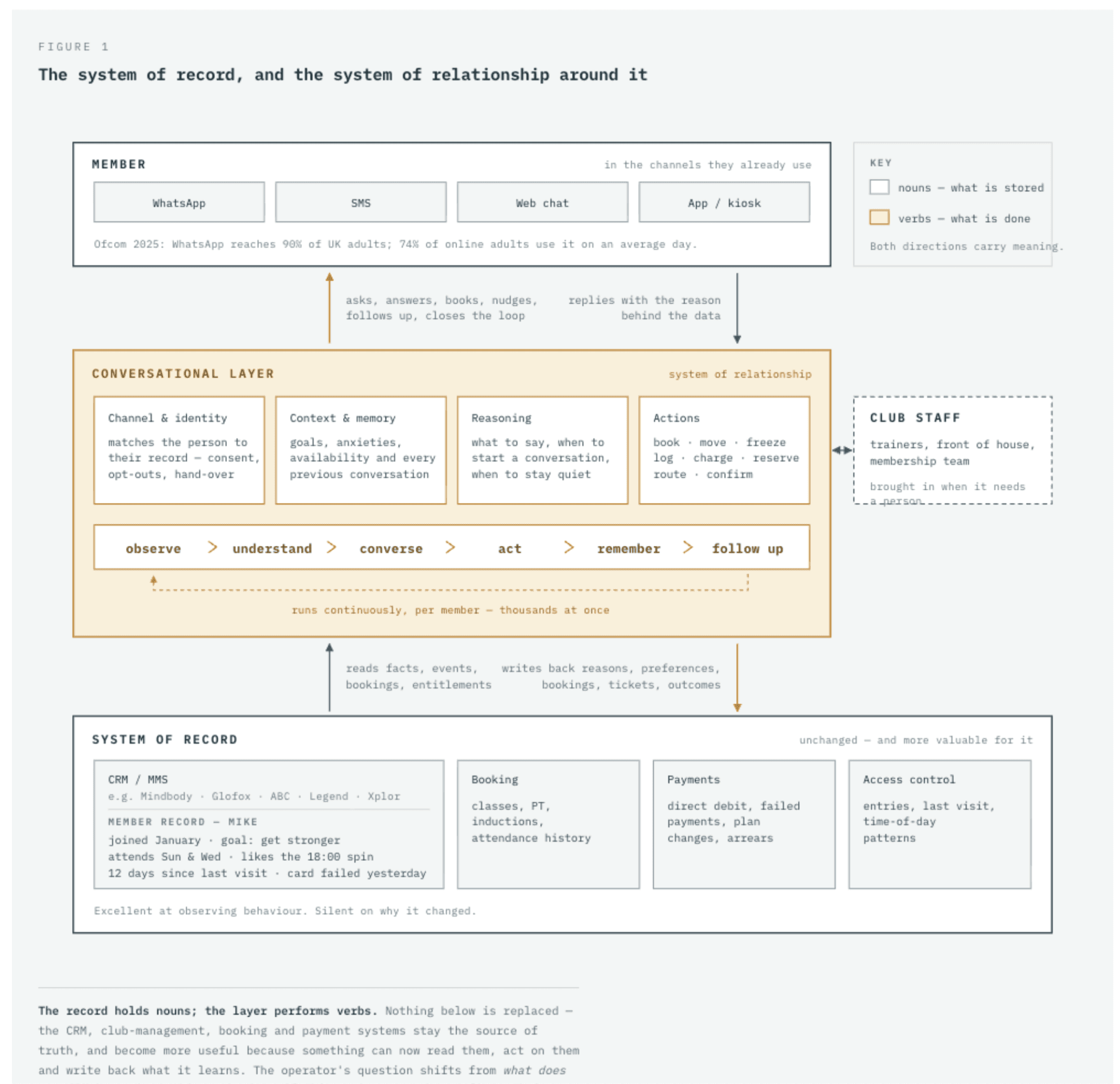
Most digital systems are extremely good at observing behaviour. They can tell us that a member hasn’t visited for three weeks or that a direct debit failed. But finding out why and responding in-context and with empathy is a different problem. People will tell conversational systems the reason behind the database facts: “I’m working nights now” or “I changed my card”
Until now, having those conversations at scale has been economically impossible. A club with 5,000 members cannot employ enough people to personally check in with everyone, remember every previous interaction and be available whenever a member wants help. Conversational AI changes the economics of that. For the first time, a club can potentially maintain thousands of individual, two-way relationships continuously without needing thousands of staff hours to do it.
The end of the silent membership?
A person can pay a club every month for years while barely ever having a meaningful conversation with the organisation. We call them a member and we say we have a relationship with them. Yet in many cases the relationship consists largely of transactions and marketing messages. Conversational AI gives us an opportunity to reconsider that.
Not by replacing the CRM. Not by adding another chatbot in the bottom-right corner of a website, but by placing a conversational layer around the systems the club already uses and allowing the organisation to listen, remember, respond and act.
The question for operators may therefore be changing. It is no longer simply: What does our CRM know about this member? It may increasingly be: If this member wanted to talk to their club right now and get something done, could they? And perhaps, just as importantly, would the club know when it should start the conversation itself?
If this is the conversation your own members aren't having yet, AllSet's Conversation Ops runs exactly this layer, across the channels members already use, for fitness operators today. Worth twenty minutes to see what it would look like inside your own club.
Continue reading
More from AllSet

Insights
Three problems facing academies and awarding bodies
Academies, awarding bodies, registers and professional networks share three problems nobody names together: enquiry speed, no real position on AI and no visibility once someone qualifies.

Insights
6 industries where the real operation happens in a group chat
Six industries, one shared gap: dispatch, recall, cover and even deal terms happen in a group chat, not the CRM, the scheduling tool or the software each business paid for.

Conversation Ops
What a communication audit reveals
Most operators think a communication audit checks response times. What it actually finds is where SMS, WhatsApp, Instagram DMs and internal messaging are quietly costing money or creating risk.
